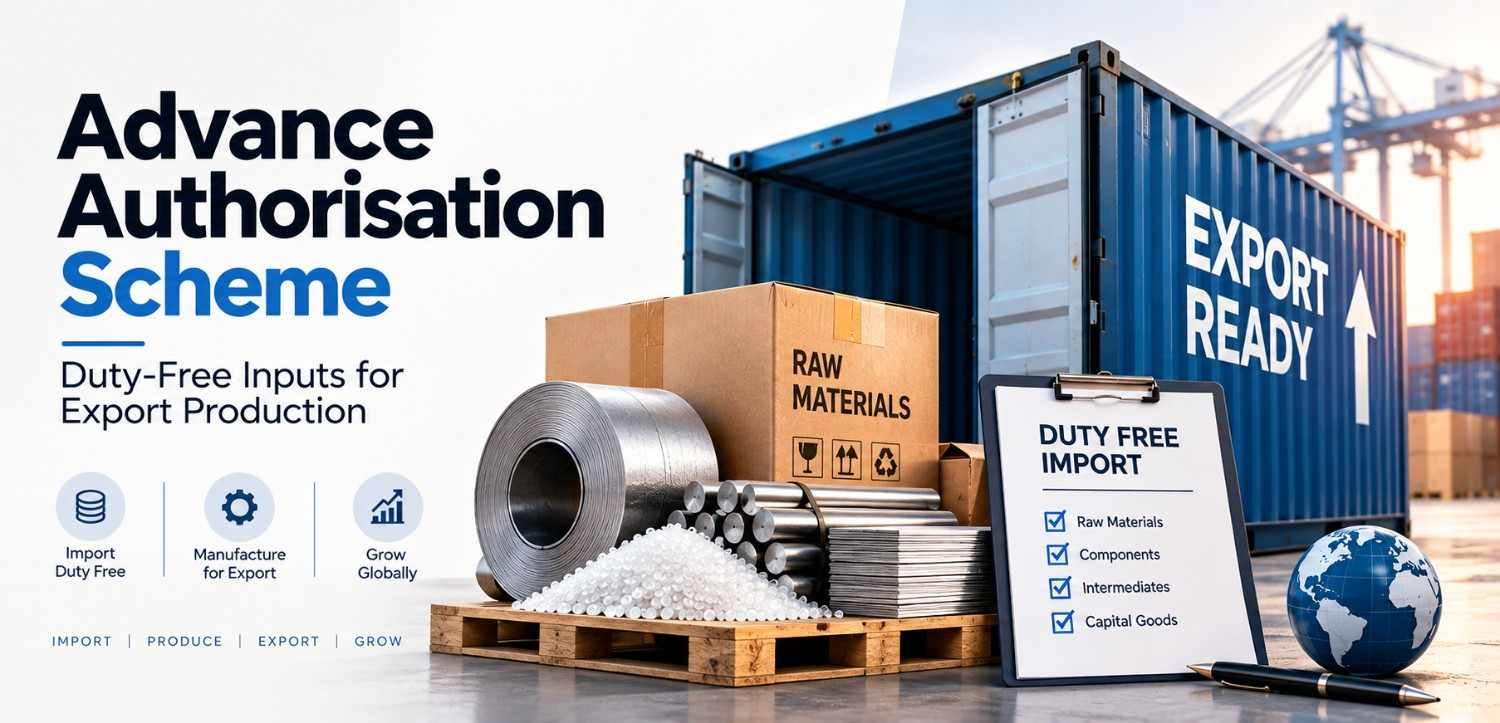
Import raw materials and inputs duty-free when they go into export production. Covers eligibility, export obligation, and 2026 EODC clearance updates.
If a chunk of your production cost is imported raw material, the Advance Authorisation scheme is worth understanding properly — it's one of the more direct ways to remove customs duty from your input costs on export orders.
What It Covers
The Advance Authorisation Scheme allows duty-free import of inputs that are physically incorporated into an export product (making normal allowance for wastage), along with fuel, oil, energy and catalysts consumed in producing the export goods. It's meant for inputs tied to a specific, identifiable export order or a standard input-output norm — not general-purpose stockpiling.
Authorisations can be issued for physical exports, deemed exports, and intermediate supply, and are available as standard Advance Authorisation or, for larger repeat exporters, Advance Authorisation for Annual Requirement.
The Core Trade-Off
Like EPCG, this isn't a no-strings benefit — you commit to an export obligation using the duty-free inputs, within a defined period, and the authorisation is closed out through an Export Obligation Discharge Certificate (EODC) once DGFT verifies you've met it.
2026 Relief Measures Exporters Should Know
- Automatic EO extension: the same Public Notice No. 51/2025-26 (6 March 2026) that extended EPCG deadlines also covers Advance Authorisations — including Annual Requirement and Special Advance Authorisation — whose EO period was expiring between 1 March and 31 May 2026, pushing the deadline to 31 August 2026 automatically, with no application or fee needed.
- Faster EODC clearance: DGFT ran a special drive (extended to 31 May 2026) specifically to clear pending EODC applications, closing over 11,700 cases in one reporting window — including more than 7,500 under Advance Authorisation alone. If you have an old, unresolved EODC application, it may be worth following up given this push toward clearing backlogs.
- Paperless duty verification: per Trade Notice No. 15/2026-27 (5 August 2026), DGFT introduced license-wise voluntary duty payment details on its portal to speed up EODC verification against Customs/ICEGATE records for payments made on or after 1 August 2026.
Getting Started
You'll need a valid IEC, a clear input-output relationship for your product (either against a standard SION norm or an ad-hoc norm application), and realistic visibility into your export order pipeline before applying — the export obligation is tied to actual, verifiable exports, not projections.
This article is for general information only. Duty structures, EO periods and documentation requirements are set by DGFT notification and can change — confirm current terms with DGFT or your customs broker before applying.