
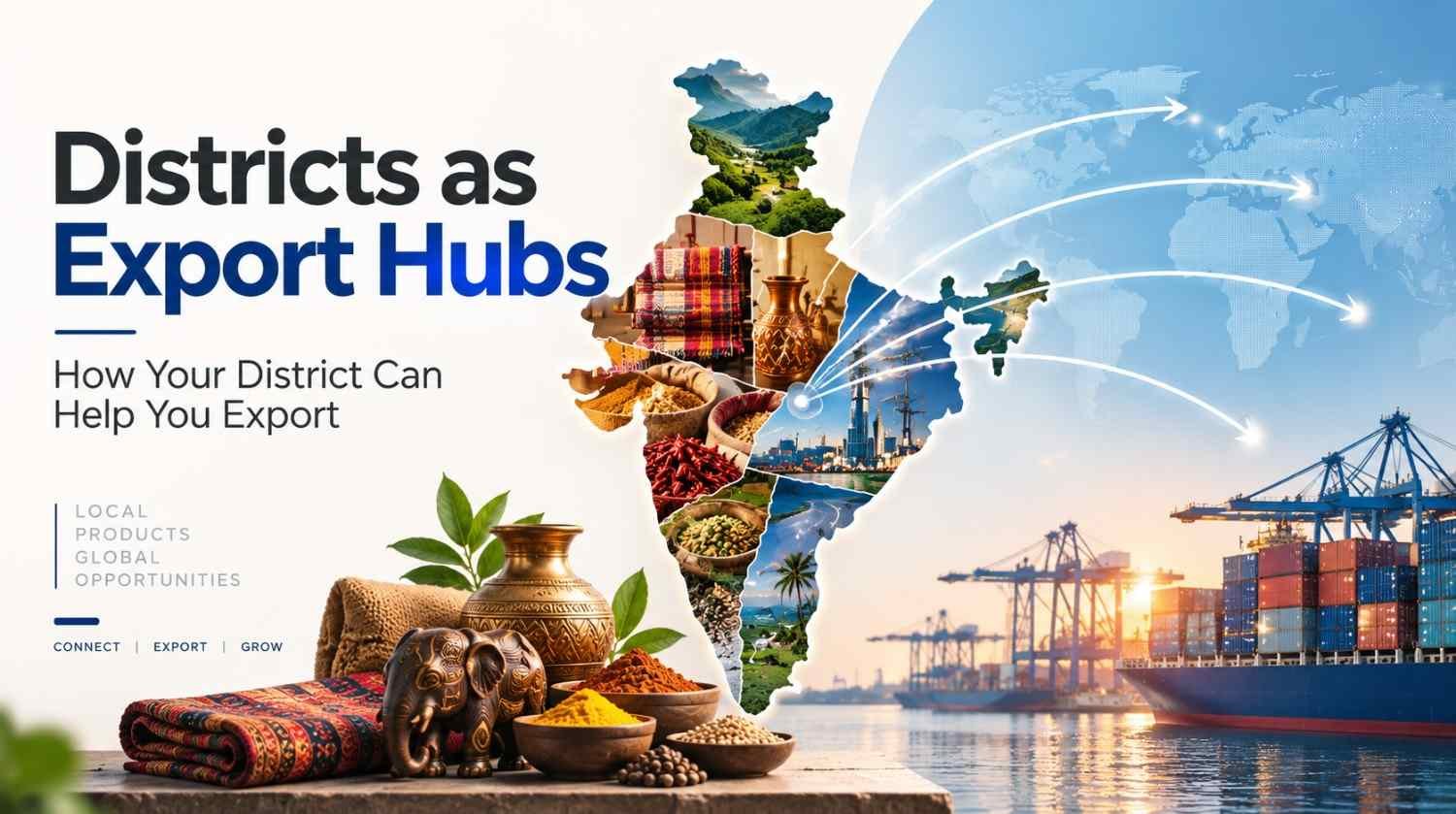
A government framework now covering 770+ districts is actively identifying local products for export — including handicrafts, agriculture and MSME clusters.
If you're a manufacturer or supplier outside a traditional export hub — a smaller town, a district known for one particular craft or crop — there's a government initiative specifically built to bring your products into the export pipeline, and it's expanded fast in 2026.
What "Districts as Export Hubs" Actually Is
The Districts as Export Hubs (DEH) initiative, proposed under Foreign Trade Policy 2023–28, is not a standalone funding scheme — it's a coordination framework that converges existing central and state government schemes around district-level export planning, building on the earlier One District One Product (ODOP) concept.
Each covered district gets a District Export Promotion Committee (DEPC), which prepares a District Export Action Plan (DEAP) — mapping which local products and services have export potential, assessing logistics and infrastructure gaps, identifying bottlenecks, and recommending interventions to improve market access.
How Far It's Reached
As of January 2026, DEH covered more than 770 districts across India. By March 2026, draft DEAPs had been prepared for 590 districts, with 249 formally adopted by their respective committees. From 1 June 2026, the government moved to a more focused, phased, outcome-oriented rollout across 27 states and union territories, supported by 24 DGFT Regional Authorities and 11 partner agencies — shifting emphasis from paperwork completion to measurable outcomes like new-exporter counts and actual export value growth.
Products already identified through this process include things like Jalgaon bananas, Bastar iron craft, Sabarkantha ceramics and tiles, and Meghalaya mandarin oranges — a useful signal of how broad "export-worthy" is meant to be under this initiative, well beyond conventional industrial exports.
The Three-Tier Structure
- Centre: Department of Commerce sets policy direction; DGFT coordinates and monitors implementation nationally
- State: State Export Promotion Committees, headed by the Chief Secretary, guide implementation and convergence across departments
- District: DEPCs prepare and monitor the local DEAP, working with the local DGFT Regional Authority
Why This Matters If You're a Smaller Supplier
If your business is based outside a metro trading hub, DEH is essentially the government's structured attempt to find you and connect you to export demand — including GI-tagged products, agricultural clusters, and MSME manufacturing clusters that wouldn't otherwise show up on a typical exporter's radar. It's worth checking whether your district has an active DEPC and an adopted DEAP, since that's often the entry point for other convergent scheme benefits (infrastructure support, capacity-building programmes, export promotion outreach).
This article is for general information only. DEH implementation status varies significantly by district and is still expanding — check with your local DGFT Regional Authority or district administration for your district's current status.